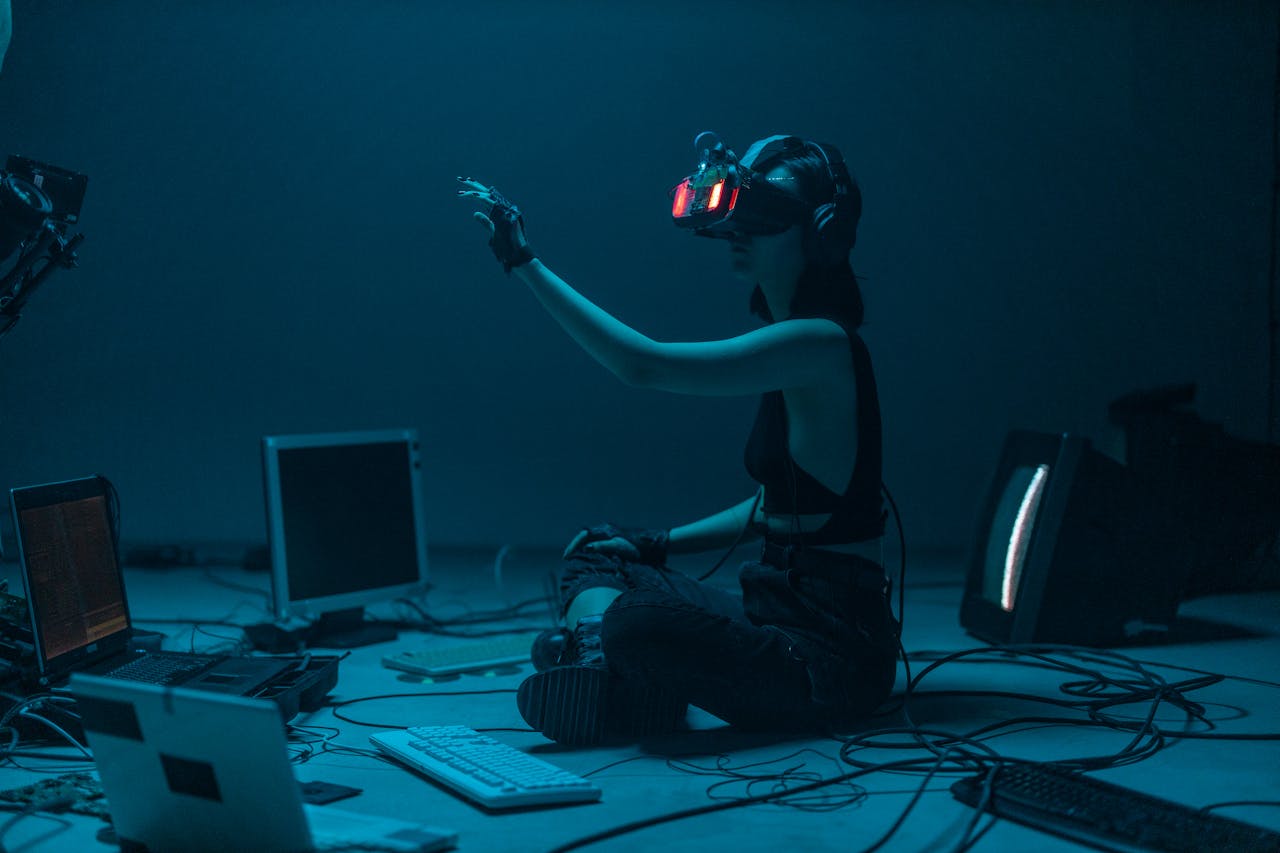
Technology is a powerful force with which we must live responsibly.
Conscience of Artificial Intelligence: Ethics, data protection and the fundamentals of responsible use (MI-series 5/5)
1. Introduction: Why is ethics the last big question of AI?
For thousands of years, man has tried to understand his own thinking, its ways and methods. How can we, with the help of our brain, perceive, understand and manipulate things much larger and more complex than the brain? The field of AI research is even higher: Not only does it try to understand the meaning, but it also attempts to reproduce and produce it by technological means.
We are at the end of our five-part series. On previous occasions, we mapped the history of AI from its beginnings in 1943 through the Dartmouth Conference in 1956 to milestones such as Deep Blue's victory in 1997 and AlphaGo's victory in 2016. We have seen the mathematical elegance of neural networks and machine learning, but now, at the end of the series, we have to ask the most important question: what happens to the ‘human factor’? As impressive as an algorithm is, if it lacks responsibility and awareness, its application can do more harm than good. As an ethical consultant, I believe that AI is not just a software development issue, but a social and moral commitment. In this post, we look behind the code and look at the obligations of using the technology of the future.
2. The maze of data protection: Personal data and public models
Data is the basis and ‘fuel’ of AI systems. As stated in the engineering guidelines of the Budapest University of Technology and Economics (BME), the responsibility of developers and users goes beyond mere coding. Part of the expected engineering attitude is striving for error-free work and exemplary compliance with software and data protection rules.
As users, it is critical to understand the data management logic of AI models. We have to differentiate between static training data sets and living systems. Most free models rely on data uploaded up to a certain point in time (e.g. 2023), while modern subscription models are now able to perform live web searches. However, it is important to keep in mind: what is written in a public model often becomes part of the teaching process and can later be reflected – indirectly – in the replies of other users.
The 3 golden rules of user privacy:
- Protection of sensitive data: Never share personal IDs, bank details or confidential business documents with public AI chats. The system does not forget, and the data may be out of our control.
- Knowledge of data blocking: Always be aware of the limits of the ‘knowledge’ of a particular model. A 2023 data-locked model will not know yesterday's news unless it has a live internet connection.
- Engineering precision in prompts: Let's be precise, but avoid specific names and internal company secrets. Use anonymised examples when working with AI.
3. Why is AI ‘wrong’? – Mechanisms of pattern recognition and hallucination
Many people tend to view AI as an omniscient oracle, but artificial intelligence doesn't really think in the human sense of the word. Its operation is based on statistical probability and pattern recognition.
The essence of the probability model: AI estimates what the most likely next element (word, character or pixel) in a given context is based on a vast set of available information.
Let's take the example of AiLumination: if the AI has learned from the data that the cases after the word ‘apple’ are 70%in ‘red’, 20%‘Green’ and 10%in ‘yellow’, the most likely addition will be ‘apple is red’. This mechanism also gives rise to the phenomenon of ‘hallucination’. When AI is asked what to cook when there are eggs, bread and pickles at home, the model does not ‘know’ what dinner is. It simply recognizes the pattern and generates the most likely sequence: ‘Make fried bread’.
Hallucination occurs when mathematical probability generates a relationship that does not exist or is wrong in reality. This is not a deliberate lie on the part of the machine, but a corollary of the operation of the statistical model: the machine is looking for the most likely next word at all costs, even if it does not have real facts in its possession.
4. Bias behind the code: From Mathematical Weights to Social Prejudices
The deepest layer of ethical dilemmas is rooted in mathematical foundations. A Perceptron learning rule During the Algorithm weights (wi) assign input data. According to András Erik Csallner, the model also uses an extra attribute whose value at each point is constant 1 – this is bias (b), which assists in the displacement of the decision hyperplane.
Technically speaking, the bias (bias or bias) is required for mathematical optimization. The problem begins when the input ‘noisy data’ carries social biases. If in a previous credit scoring database certain groups suffered a systemic disadvantage, the algorithm will learn this pattern and convert it into mathematical weights. In this case, the machine will treat past injustices as ‘objective truths’.
A Decision trees They can help filter out irrelevant variables, but developers have a huge responsibility: You have to understand that math wi and b Behind these values lies the fate of people of flesh and blood. Distortion due to “noisy data” is not only a statistical error, but also a moral risk that needs to be combated with conscious control and diverse teaching data.
5. Plagiarism and Intellectual Property in the Age of AI
As AI draws its knowledge from human-generated documents and works available online, the issue of intellectual property is unavoidable. AI is an excellent assistant in brainstorming and summarizing, but the ethical obligation of self-creation and source marking remains with the person.
| Function | Ethical procedure | Risk |
|---|---|---|
| Summary | Indication of original sources and documents. | Uncritical acceptance of hallucinations. |
| Idea | AI is just a starting point; the final work requires its own added value. | Accusation of plagiarism, loss of a unique tone. |
| Data extraction | All data shall be verified from at least two independent sources. | Dissemination of fake news. |
Transparency is the key to responsible use: Admit it, when drafting a text with the aid of AI, and always respect the work of the original human authors from which the machine learned.
6. AI in education and everyday life: Responsible use
In education, AI cannot replace critical thinking, but should rather be seen as a kind of ‘training partner’. It's worth taking over the information technology. anytime decision tree and anytime classificator approach. These algorithms are able to make a (even inaccurate) decision in a very short time and then continuously refine it depending on the time available.
In human learning, this means a balance between quick, intuitive response and slow, reflexive analysis. AI can give you a quick answer, but it's our job to refine.
Steps for the conscious use of AI in education:
- Reflection: Let's ask the question: Why did the machine give that answer? What data could it have been based on?
- Critical analysis: Look for inconsistencies and logical loopholes in the generated text.
- Discussion topics: Ask AI to argue against our own position, thus improving our reasoning skills.
- Self-monitoring: All facts reported by AI should be compared with the official curriculum or literature.
7. Future perspectives: From the Turing Test to Rational Action
The Turing Test and the Loebner Prize
Alan Turing's vision, published in 1950, is still fundamental today. Already in 1947, in his lectures, he outlined the fundamentals of machine learning and supervised learning. The Loebner Prize, founded by Hugh Gene Loebner in 1990, has not yet won the $100,000 grand prize in the Turing Test. For a machine to be truly ‘human’ in the sense of the test, according to Csallner (2024), it needs four core capabilities:
- Knowledge and use of English (or any natural language).
- Storage of knowledge (database).
- Automated justification based on stored knowledge.
- Machine learning to adapt to new circumstances.
The extended version of the test would require three additional capabilities: machine vision, speech comprehension and robotics (movement).
Rational agents and limitations
Modern research is no longer just about thinking, but about Rational Action It also targets. So-called agents work independently in their environment, achieving goals and adapting to changes. However, we also have to face the mathematical limitations: Kurt Gödel's 1931 non-completeness theorem and the theory of NP-completeness remind us that there are problems that the machine (and perhaps man) cannot solve perfectly. A machine can make a rational decision based on a formal logic, but moral responsibility – especially in situations where there is no clear ‘good’ decision – always remains the privilege and duty of man.
8. Summary and closing of the series
During the 5 episodes of our series, we explored the monumental path of the development of artificial intelligence. We understood that AI is not magic, but a precise system of algorithms, data, and mathematical weights. We saw how a neural network was built and how the initial theoretical models of 1943 became part of our everyday lives.
Technology is now capable of writing, diagnosing, or even leading, but conscience cannot be programmed. It's like a mirror: It learns from our data, our decisions, and our social patterns.
Artificial intelligence (AI) gives us a huge opportunity to facilitate everyday work and lifelong learning. Use it with openness and curiosity, but always remain conscious and critical. Technology can evolve exponentially, but the values by which we apply it are ourselves. Responsibility does not belong to the machine, but to the person who hits the enter.