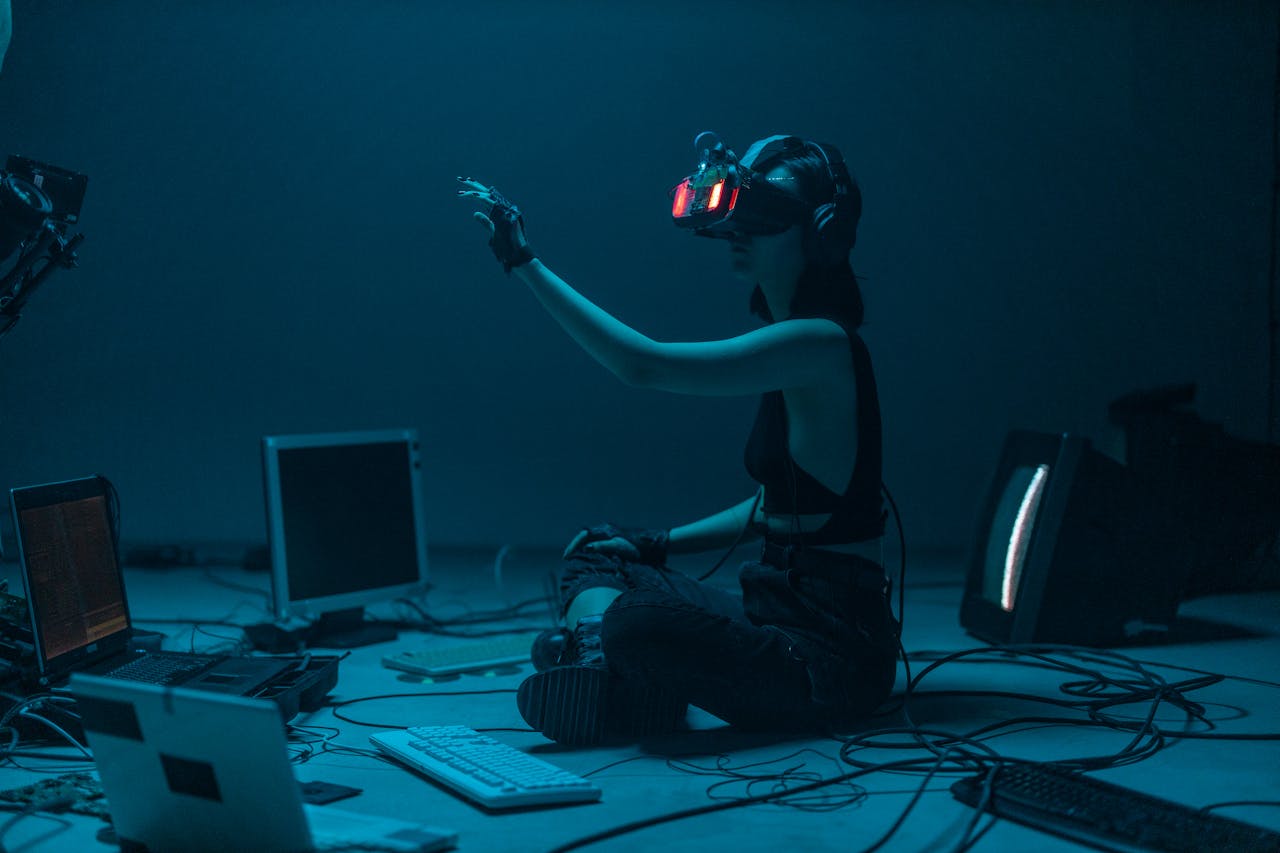
AI is no longer the distant future, but the invisible helper of our everyday lives.
AI in practice: From Robotics to Speech Recognition (Part 4)
1. Introduction
A testarypeter.hu In the fourth chapter of this five-part series of articles, we move from theoretical principles to tangible applications. The mathematical models discussed in the previous sections and the the Cognitive Sciences his findings, which explore the regularities of human thinking, put into practice the Rational action Incarnate by principle. Artificial intelligence (AI) is no longer just an abstraction of research laboratories, but a technological reality that shapes our daily lives and is able to function independently and purposefully through agents in harmony with its environment.
2. The world of robotics: Physical extension of AI
Robotics is the branch of AI responsible for physical expansion, movement, and manipulation of objects. While software solutions work with virtual data, robots are the physical interfaces of AI that interact with reality through sensors and actuators.
Historical and economic context
The practical benefits of AI were already apparent in the 1980s during the boom in expert systems and early robotics. That's when technology became a billion-dollar business. An excellent example is DEC's R1 system, which saved DEC $40 million a year in the mid-1980s by optimizing industrial processes.
Extended Turing Test and Physical Dimension
The requirements of modern robotics go beyond classical text communication. The extended version of the Turing test also requires physical interaction: the machine must be capable of sensing and moving relevantly in the environment.
Basic operating cycle of robotic systems:
- Data collection: Entering environmental information through sensors.
- Decision: Algorithmic processing to determine the rational step.
- Action: Movement of physical interveners (motors, actuators).
Types: Special and General MI
At present, robots are primarily Weak AI They belong to the category of Narrow AI, where they perform specific tasks, such as the navigation of autonomous vehicles. However, the long-term goal of the research is to Strong AI (General AI), which carries the ability to move and adaptively solve tasks at the human level.
3. Machine vision: Processing the visual input
Machine vision is the most important sensory channel for AI, enabling the digitisation of the environment and the identification of objects. This process is essential for measuring advanced intelligence and complex navigation.
Digitisation and noise management
When processing visual information, the machine must handle ‘noisy’, erroneous or incomplete data from the physical reality. To this end, Probability Calculation Models This allows the system to detect patterns despite visual interference.
Learning process and classification
In machine vision, the supervised learning dominant: the system is taught with tagged data pairs. The core of the process is classification, where the input image, for example in the case of a facial recognition system, is assigned to a specific category or person.
‘Alan Turing’s vision of 1950 is that in order to achieve human-level intelligence, a machine must have three complementary capabilities beyond communication: machine vision to recognise objects, speech understanding and robotic abilities to move.’
4. Virtual Reality (VR) and the Symbiosis of AI
The relationship between virtual reality (VR) and AI is symbiotic: AI makes simulated spaces more lifelike, and VR provides a safe environment for teaching AI agents. In this environment, agents must make rational decisions in response to environmental changes, even with limited information.
The main applications of VR in combination with AI are:
- Education: Interactive simulations to develop cognitive skills.
- Business simulations: Modelling industrial processes and workflow optimization.
- Risk-free training: Practice complex operations where a real error would be fatal.
5. Speech Recognition and NLP (Natural Language Processing)
Natural Language Processing (NLP) builds on the foundations of computer linguistics, morphology and segmentation to enable the interpretation of human speech.
Mathematical models: Statistical and HMM Basics
Modern systems adopt a probabilistic approach, often building on the logic of hidden Markov models (HMMs) or statistical language models. These algorithms do not ‘think’, but identify patterns based on big data.
Interaction and generation
The functionality of ChatGPT and similar models is the pinnacle of pattern recognition. The system interprets the question, then determines the structure of the answer on a statistical basis with the help of the learned connections.
How does it work? – Technical logic Based on the input text, the AI calculates the following most likely word or letter. If the sentence begins: ‘Apple…’, the model does not contemplate the concept of fruit, but uses its data to identify whether ‘red’, ‘green’ or ‘sweet’ elements are statistically most likely to follow.
6. Under the ‘engine bonnet’ of the algorithms: Machine learning in practice
Basic design principle for the implementation of practical AI Ockham's Razor: We choose the simplest of several consistent hypotheses (e.g., a first-degree polynomial versus a seventh-degree polynomial), because simpler models tend to be more generalized and allow for faster running.
Decision trees and neural networks
A Decision trees They come through a series of questions. Applied in Senior Level Development anytime decision tree The technique allows the system to make a decision over time, albeit not necessarily optimally, which is continuously refined as a function of the available time.
The more complex tasks are neural networks treated. It is important to mention here the Bias The definition of perceptron in the perceptron model x0 appears as a constant unit, ensuring the flexibility of the model. The power of deep learning AlphaGo His success in 2016 proved it, where the machine surpassed the human world champion in an extremely complex board game.
Developer environment and tools
For practical implementation, the experts are Python They use the environment, relying on the following critical libraries:
- numpy/scipy: Basic mathematical and scientific operations.
- pandas: Manage structured data.
- sklearn: Machine learning algorithms and classifiers.
- tensorflow / keras: Building deep learning architectures.
Problems and practical AI solutions
| Type of problem | Practical AI solution |
|---|---|
| Classification | Face recognition, Credit assessment (Yes/No decision) |
| Regression (Regression) | Weather forecast, Estimation of property prices |
| Clustering | Automatic segmentation of customer groups |
7. Summary and outlook
From robotics to speech recognition, we see that the practical application of AI is based on a balance between mathematical precision and engineering simplicity (Ockham's razor). The key to development is responsible AI development, which strives for effective human-technology cooperation while adhering to ethical standards. The final part of the series will focus on the future of AI and social impacts.